| 2005 |

|
YEAR BOOK |
Martin Ryan Institute, NUI, Galway
|
AlgaeBase – listing the world's algae
|

Science Foundation Ireland (http://www.sfi.ie) has identified Information Technology as a prime technology in empowering Ireland well beyond the current Celtic Tiger phase and is investing heavily in research in this area, including a project at NUI, Galway's Digital Enterprise Research Centre ( http://www.deri.ie ) to research the next generation of smart web browsers. These will be better able to sense what the user wants and distil the enormous complexity of the web to something that is instantly useful. AlgaeBase is doing the same thing – it is trying to bring order and sense to a hugely complex world of information on algae.
The building blocks of communication in biology are names. Love 'em or hate 'em, these Latin and Greek names are simply a way of communicating what we know about organisms. The science of ordering these names in a coherent way that reflects their evolution is known as taxonomy. We have developed a complex set of rules to decide how we order these names, known as nomenclatural rules, which is agreed internationally under a Botanical Code, a Zoological Code and a Bacteriological Code. All are similar in some ways and quite different in others and have given rise to another science, nomenclature, which relates to the rules that we have agreed for names. To the outsider, there seems nothing more irritatingly petty than some of the rules of nomenclature!
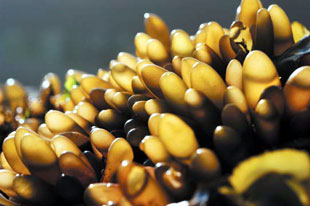
Worry not, dear reader, for the internet rides to the rescue. Instead of spending a life accumulating rooms full of dusty books (and handwritten notes from the ones you can't afford), and making and tending drawers full of card indexes, it can all be done digitally. Put your stuff in a database, and store it all on a computer, where you can retrieve it easily and quickly.
Next step: why not make it available to other people? Well, that is easy too. The current simplicity of the web and its openness (and anarchy) lends itself to instant publication of databases. And this is exactly what we have done for algae.
I'm a marine botanist and my area of interest is taxonomy and biology of marine algae, particularly red algae. In 1996, I started to put information about common seaweeds of Ireland and north-eastern Europe on the site http://www.seaweed.ie . Much to my surprise, it proved very easy to make a database engine to run that part of the site. So, like Topsy, AlgaeBase grew from a seaweed database for the north–eastern Atlantic and Mediterranean to a seaweed database for the whole world. It then became apparent that the attached marine and brackish-water algae could not be isolated from the freshwater, terrestrial, and subaerial algae, not to mention the freshwater and marine phytoplankton.
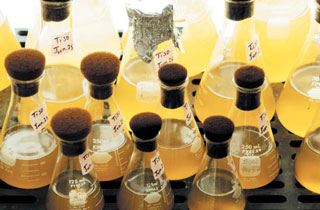
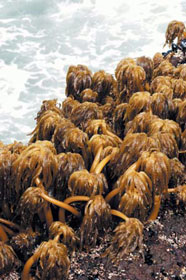
Nevertheless, there is an inherent conflict in what AlgaeBase does, and it is one that in some ways plagues the internet. Nothing included is truly fixed. When one publishes a book, the information is fixed on the paper and does not change over time (well, until the book rots). The upside is that one can cite a source like this easily; the downside is that the information cannot be updated. With web sources the converse is the case. In the case of AlgaeBase and other Global Species Databases, the data also need to be spread as widely as possible by making mirror sites, providing datasets for World Species databases, and storing data in various ways.
Funding
For the last five years AlgaeBase has been generously funded by the Higher Education Authority under the Priority Research in Third-Level Institutions Programme. We are also the coordinators of a European Union FP5 project called SeaweedAfrica ( http://www.seaweedafrica.org; see page 76 ).
However, existing funding ceases before the end of 2005 and activity will slow down considerably after this. It does not seem possible that the present staff will be retained unless funding becomes available. The replacement of equipment and funding of programming will not be possible without a major sponsor. Unfortunately, if this current situation persists a valuable asset to the Irish biodiversity community and Irish science will quickly begin to become obsolete and lose its footing on the world stage.
| Some organisations using AlgaeBase data | |
| At present, AlgaeBase is the accepted authority that contributes algal data to the organisations shown here: | |
| Global Biodiversity Information facility | http://www.gbif.net |
| Species 2000 | http://www.species2000.org |
| GenBank | http://www.ncbi.nlm.nih.gov/Taxonomy/ |
| Ocean Biogeographic Information System (OBIS) | http://www.iobis.org |
| Species 2000 Europa | http://sp2000europa.org |
| European Network for Biodiversity Information | http://www.enbi.info |
| Codes for Australian Aquatic Biota | http://www.marine.csiro.au/caab/caabsearch-frames.htm |
| Marine Biodiversity and Ecosystem functioning (MARBEF) | http://www.marbef.org |
|
|
|
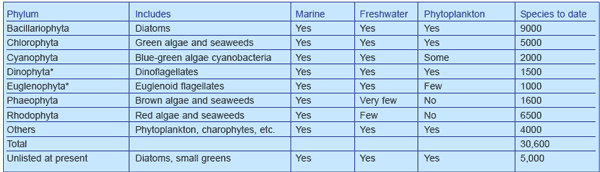
| Main phyla of algae represented in AlgaeBase are shown in the table below. (Asterisked phyla are often included in the Protozoa. The Cyanophyta are considered to be bacteria.) |
|
What are Algae? The answer is a little disconcerting: algae is a generic term for a number of supposedly primitive, seemingly plant-like, generally photosynthetic organisms, that generally form spores of some kind and that are scattered amongst at least four Kingdoms: Bacteria (cyanophyta or cyanobacteria), Plantae (green algae, charophytes, etc.), Chromists (brown algae, diatoms, etc.), and Protozoa (dinoflagellates and euglenoid flagellates), and fall into two Empires (Prokaryotes and Eukaryotes). Actually, the term algae is pretty meaningless in the face of this extraordinary diversity. Nevertheless, it is a term of convenience as most people in the scientific world know to what you are referring, although their mental picture may be sort-of-plants that are not flowers, not mosses, not ferns, not fungi, and not primitive enough to be viruses or bacteria. All pretty negative, but then an expert is probably the worst person to ask. Some algae are of huge importance to the climate, such as coccolithophorids that may form open-ocean blooms the size of Co. Galway, and it is widely recognised now that, contrary to previous estimates, most carbon is fixed in the sea, and most of this is fixed by algae, many of them very tiny things called picoplankton. Other more familiar algae such as seaweeds also affect the climate by producing DMS (dimethyl sulphide) and iodine, both of which are responsible for the nucleation (seeding) of clouds. |
Contact: Professor Michael D. Guiry, AlgaeBase Centre,
Martin Ryan Institute, National University of Ireland, Galway
E-mail: [email protected]